




Modern Rice Milling Systems and the Importance of Rice Rubber Rollers
Rice is one of the world’s most important staple foods, feeding billions of people every day across Asia, Africa, and many other regions. Beyond being a daily food source, rice also plays a critical role in global agriculture, food security, and economic development.
Today, consumers are increasingly concerned not only about rice quantity, but also about rice quality. Aroma, texture, appearance, nutritional value, and food safety have become essential factors in the global rice market. Behind every bowl of premium-quality rice is a carefully controlled milling process designed to preserve grain quality while maximizing production efficiency.
Modern rice milling systems have evolved significantly over the years through automation, engineering innovation, and advanced processing technology. Among all components used in rice processing, rice rubber rollers are considered one of the most important parts in achieving stable milling performance and reducing broken rice.
This article explores how modern rice milling systems work, the key stages of rice processing, and why rice rubber rollers play a critical role in the rice milling industry.
The Global Importance of Rice
Rice remains the primary food source for more than half of the world’s population. The Asia-Pacific region alone accounts for over 90% of global rice consumption, making rice production and rice processing essential industries in many countries.
As living standards continue to improve, consumers increasingly expect rice products with:
- Better aroma and flavor
- Softer and more consistent texture
- Cleaner appearance
- Higher nutritional quality
- Lower broken rice percentage
- Better food safety standards
Different countries and cultures also prefer different rice characteristics depending on local eating habits and amylose content preferences. As a result, rice mills must continuously improve milling technology to meet changing market demands.
Rice Cultivation and the Paddy Life Cycle
Rice cultivation is a long and highly controlled agricultural process. Depending on the rice variety and environmental conditions, the rice plant life cycle generally ranges from 100 to 210 days.
Rice is commonly cultivated using two primary farming methods:
- Lowland rice cultivation
- Upland rice cultivation
Today, there are more than 7,000 rice varieties worldwide. Farmers continuously face environmental and operational challenges such as:
- Climate change
- Water management
- Soil conditions
- Pest control
- Seed quality
- Temperature fluctuations
All of these factors directly influence the final quality of paddy rice and eventually affect milling performance inside the rice mill.

Above image is used to illustrate the six-stage development of a paddy rice plant’s life cycle. (which takes around 100–210 days to get cropped in the final). There are two ways to cultivate of rice: upland and low-land
There are more than 7000 rice varieties in the present day. The cultivation of rice presents numerous challenges for farmers in terms of monitoring the plant’s health and addressing environmental concerns. (water, land, species, weather change). All of the components necessitate years of expertise and shrewdness in the management of paddy grain facilities.
Understanding Modern Rice Milling Systems
Rice milling is the process of removing the husk and bran layers from harvested paddy rice to produce edible white rice.
The main objectives of a rice milling system are:
- Maximizing whole grain recovery
- Reducing broken rice
- Improving rice appearance
- Preserving grain texture and nutritional quality
- Increasing milling efficiency
- Enhancing market value
Depending on the level of technology and production scale, rice milling systems may operate using one-stage, two-stage, or multi-stage processing systems.
One-Stage Rice Milling System
The one-stage milling system, also known as the iron huller system, removes both the husk and bran layer in a single operation.
Although this method is simple and inexpensive, it has several limitations:
- High grain breakage rate
- Lower rice recovery yield
- Reduced rice quality
- Higher mechanical stress on the grains
Typically, the milled rice recovery rate in a one-stage system ranges from only 53% to 55%, making it less suitable for modern commercial rice production.
Two-Stage Rice Milling System
The two-stage rice milling system separates the milling process into two main operations:
- Husking
- Whitening and polishing
This approach significantly improves rice quality and reduces grain damage during processing.
In this system, paddy huskers equipped with rubber rollers are used to remove the husk efficiently while protecting the rice kernel from excessive breakage. Rice recovery rates can increase to approximately 60%, depending on machine configuration and operational conditions.
Modern Multi-Stage Rice Milling Systems
Today, most commercial rice mills use advanced multi-stage milling systems integrated with automation and precision engineering technology.
Modern rice mills are designed to:
- Reduce thermal buildup during milling
- Minimize mechanical stress on rice grains
- Improve milling consistency
- Increase production capacity
- Reduce labor dependency
- Enhance final rice quality
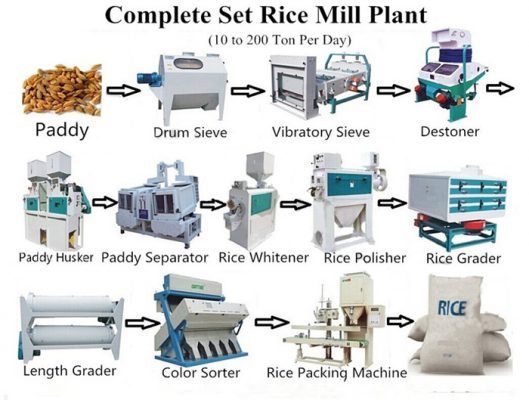
Advanced rice milling systems combine multiple processing stages into a continuous and highly efficient production flow.

This photo is the whole process of the milling system work from paddy to package.
Main Stages of the Rice Milling Process
1. Pre-Cleaning Process
After harvesting, paddy rice must first undergo cleaning before entering the milling line.
The pre-cleaning stage removes impurities such as:
- Straw
- Dust
- Stones
- Wood particles
- Metal fragments
- String and debris
- Unfilled grains
Proper cleaning is essential to protect machinery and improve milling performance.
Moisture control is also extremely important during storage. Paddy rice must be preserved in controlled humidity and temperature conditions to maintain grain quality before processing.
| Stage | Phrase | Function |
| Husker stage | Pre-cleaning | removing all impurities and unfilled grains from the paddy |
| Husking | removing the husk from the paddy | |
| Husk aspiration | separating the husk from the brown rice/unhusked paddy | |
| Paddy separation | separating the unhusked paddy from the brown rice | |
| De-stoning | separating small stones from the brown rice | |
| whitening and polishing stage | Whitening | removing all or part of the bran layer and germ from the brown rice |
| Polishing | improving the appearance of milled rice by removing remaining run particles and by polishing the exterior of the milled kernel | |
| Sifting | separating small impurities or chips from the milled rice | |
| grading, blending and packing | Length grading | separating small and large broken from the head rice |
| Blending | mix head rice with a predetermined amount of broken, as required by the customer | |
| Weighing and bagging | preparing milled rice for transport to the customer |
2. Husking Process
The husking stage is one of the most important phases in the rice milling process.
At this stage, the outer husk is removed from the paddy grain using a paddy husker machine fitted with rice rubber rollers.
The rubber rollers rotate at different speeds, creating controlled pressure and friction that gently separate the husk from the grain while minimizing rice breakage.
The husking process produces:
- Brown rice
- Rice husk
- Small quantities of broken grains
The efficiency of this process depends heavily on the quality and durability of the rice rubber rollers.
3. Whitening and Polishing Process
After husking, brown rice continues through the whitening and polishing stage.
The objectives of this stage include:
- Removing bran layers
- Increasing whiteness
- Improving surface glossiness
- Enhancing commercial value
Currently, there are two main technologies:
Friction Whitening
Using pressure and friction to remove bran layers.
Abrasive Whitening
Using high-speed abrasive rollers to remove the outer bran layer from rice grains.
4. Grading, Blending, and Packaging
After polishing, rice moves to the grading and packaging stage.
The process includes:
- Separating whole rice grains and broken rice
- Blending according to customer requirements
- Weighing and packaging finished products
Modern consumers usually prefer:
- Bright white rice
- Uniform grains
- Attractive glossiness
- Minimal impurities
Therefore, modern rice mills invest heavily in grading and quality control systems.
At this stage, visual appearance becomes extremely important. Consumers prefer rice that appears:
- Bright
- Clean
- Uniform
- Glossy
- Smooth
Modern rice mills therefore invest heavily in color sorting systems, grading technology, and automated quality control equipment.
Why Rice Rubber Roller are Important

The Critical Role of Rice Rubber Rollers
Rice rubber rollers are among the most essential consumable components in rice milling machines.
High-quality rubber rollers provide several important advantages:
- Reduced broken rice percentage
- Stable husking performance
- Improved grain protection
- Higher milling efficiency
- Consistent product quality
- Reduced machine vibration
- Longer equipment lifespan
Poor-quality rubber rollers may cause:
- Excessive grain breakage
- Uneven husking performance
- Lower production output
- Increased downtime
- Higher operational costs
For modern rice mills, selecting the correct rice rubber roller is critical for maintaining stable production and achieving premium rice quality.
The Evolution of Rice Milling Technology
Historically, rice processing required extensive manual labor.
In ancient times, rice was separated from its husk using stones, wooden pestles, and manual pounding techniques. Although effective for small-scale use, these methods required significant physical effort and time.
Today, modern rice milling technology has transformed the industry through automation and engineering innovation.
Advanced rice milling systems now include:
- Automated conveyors
- Digital control systems
- High-speed polishers
- Optical color sorters
- Precision grading equipment
- High-performance rice rubber rollers
Automation improves:
- Production speed
- Milling consistency
- Labor efficiency
- Food safety
- Energy efficiency
The Development of Rice Milling Technology
The global rice milling machinery market continues to grow steadily as rice-producing countries modernize their agricultural industries.
Many international companies are actively involved in rice milling equipment manufacturing, including:
- Bühler Group
- Satake Corporation
- Hubei Yongxiang
- China Meyer
- Zhongke Optic-electronic
- Hunan Chenzhou Grain and Oil Machinery
As global demand for premium rice continues to rise, the rice milling industry is expected to further invest in automation, smart manufacturing, and high-performance milling components. To be forecasted, “from 2023 to 2033, the global rice mill machine market is expected to grow at a slow and steady CAGR of 4.0%. The Market Valuation is projected to increase from US$ 192.1 million in 2023 to US$ 284.4 million by 2033” 
Trends in the Rice Milling Machinery Industry
The future of rice milling technology focuses on:
- Higher automation
- AI-assisted quality control
- Lower energy consumption
- Reduced grain breakage
- Sustainable production
- Smart monitoring systems
- Improved food safety standards
As quality expectations continue to increase globally, durable and high-performance rice rubber rollers will remain essential for achieving efficient milling performance and stable rice quality.
About Tan Lua Vang
With more than 30 years of experience in manufacturing rice rubber rollers and rice milling spare parts, Tan Lua Vang continuously supports rice mills in improving production efficiency and reducing broken rice percentage.
Tan Lua Vang rice rubber rollers are developed with the goals of:
- Stable husking performance
- High durability
- Reducing grain damage
- Increasing operational efficiency
- Compatibility with many modern rice milling systems
Through continuous improvement and practical industry experience, Tan Lua Vang is committed to providing high-quality rice rubber roller solutions for the rice milling industry.
Reference article: Tan Lua Vang Original Article
Major players sorted in no particular order
All data information is collected via primary and secondary research to rewrite this article.
All sources are cited with full links.
